Architecting Multi-Agent AI Systems for Enterprise - 101
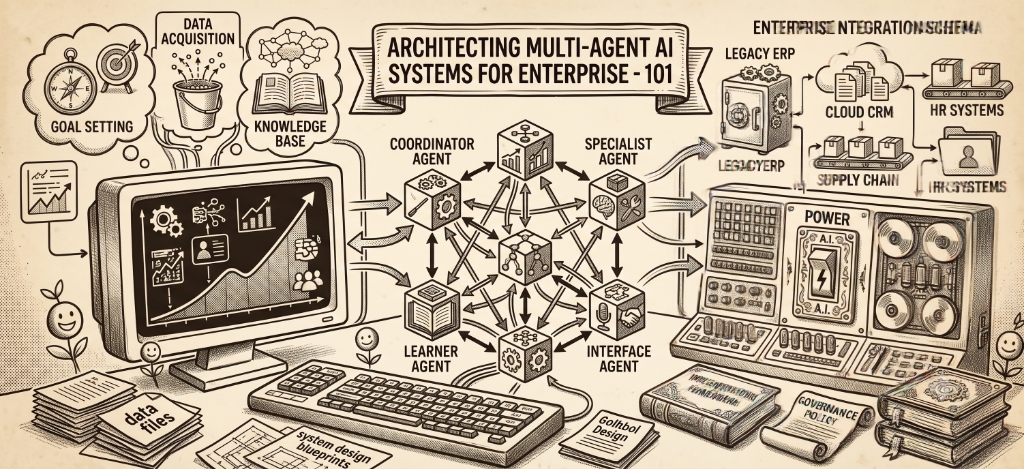
Imagine you’re the managing partner of a top-tier consulting firm, and you’ve just landed a massive, complex Mergers & Acquisitions (M&A) deal.
You wouldn’t just throw fifty junior analysts into a room with the client’s financial records and say, “Figure it out.” That would be chaos.
Instead, you break the deal down into structured workstreams. You assign specialized teams—one group handles the financial due diligence, another digs into the legal compliance, and a third audits the tech stack. You have a knowledge manager tracking the institutional memory of the deal, ensuring nobody repeats the same mistakes. Finally, you have a polished, client-facing associate who takes all these complex findings, synthesizes them, and presents them to the client for approval.
This is exactly how you should think about building multi-agent AI systems for the enterprise.
We’ve moved past the days of typing a single prompt into a chat window and hoping for the best. Today, we’re orchestrating complex, regulated enterprise workflows. But deploying agentic technology across corporate ecosystems demands more than just clever prompt engineering—it requires robust distributed systems fundamentals, governance guardrails, and modular orchestration.
The Consulting Firm: Mapping the Analogy to Architecture
To make this concrete, let’s map our M&A consulting firm to the actual architecture of an enterprise multi-agent system:
| The M&A Deal Team | The AI Agent Archetype | What They Actually Do |
|---|---|---|
| The Managing Partner | Coordinator Agent | The brain of the operation. Decomposes the goal, delegates tasks to specialists, and manages the overall “budget” (context window). |
| The Domain Analysts | Specialist Agents | Narrow, strictly scoped workers. One queries inventory, another runs code analysis. They don’t see the big picture, just their job. |
| The Knowledge Manager | Learner Agent | Tracks what works and what doesn’t. Caches frequent queries, optimizes lookups, and refines the system’s internal memory. |
| The Client Associate | Interface Agent | The bridge to the human. Presents the structured plan, handles approvals, and translates human intent into system schemas. |
The Core Challenge: Determinism vs. Agency
When you transition from this high-level analogy to actual enterprise infrastructure—core ledgers, legacy ERPs, customer CRMs—you hit a wall: Large Language Models (LLMs) are probabilistic, but the enterprise demands determinism.
You can’t have an AI hallucinating a database drop. You need absolute auditability and zero tolerance for uncontrolled side effects.
When architecting these systems for production, I always rely on four primary tenets:
- Explicit State Machines Over Freeform Loops: Rather than granting agents unconstrained tool-calling loops, agents operate within structured workflow graphs. State transitions are verified and logged immutably.
- Deterministic Validation Boundaries: Every agent output that triggers transactional operations passes through hard boundary validators (schema enforcement, authorization checks, and budget bounds) before any state mutation occurs.
- Decoupled Planning and Execution: A planner decomposes high-level intent into directed acyclic graphs (DAGs) of discrete tasks, while specialized worker agents execute individual steps with bounded tool scopes.
- Strict Governance & Policy Enforcement: Business rules, compliance protocols, and permission scopes live in explicit policy engines outside the LLM context.
The Enterprise Multi-Agent Topology
In high-concurrency enterprise settings, naive conversational chaining between agents introduces compounding latency, hallucination drift, and failure cascading. Instead, production systems structure agent responsibilities into distinct modular archetypes, much like our consulting firm:
[ Enterprise Goal / User Intent ] │ ▼ ┌─────────────────────┐ │ COORDINATOR AGENT │ ◄─── [ Governance Policy & Auth ] │ (Planning & DAG) │ └──────────┬──────────┘ │ ┌───────────────┼───────────────┐ ▼ ▼ ▼ ┌─────────────┐ ┌─────────────┐ ┌─────────────┐ │ SPECIALIST │ │ LEARNER │ │ INTERFACE │ │ AGENT │ │ AGENT │ │ AGENT │ └──────┬──────┘ └──────┬──────┘ └──────┬──────┘ │ │ │ ▼ ▼ ▼ [ Enterprise Integrations ] [ Human-in-the-Loop ] • Legacy ERP • Cloud CRM • Supply Chain • HR Systems1. The Coordinator Agent
The brain of the orchestration layer. Responsible for goal decomposition, context budgeting, and synthesizing sub-agent responses. The Coordinator decomposes complex enterprise tasks into discrete execution DAGs, but never interacts with raw external databases or write APIs directly.
2. The Specialist Agent
Domain-specific workers with narrow, strictly scoped toolsets (e.g., querying inventory levels, executing accounting reconciliations, or running code analysis). Restricting tool breadth significantly mitigates hallucination and isolates security blast radiuses.
3. The Learner Agent
Maintains memory loops, tracks heuristic evaluations, and refines knowledge retrieval. It monitors execution success rates, caches frequent query patterns, and optimizes internal vector store lookups without modifying core system logic on the fly.
4. The Interface Agent
Acts as the communication and safety bridge between the multi-agent mesh and human operators. It presents structured plans, handles human-in-the-loop approvals for high-stakes decisions, and translates ambiguous human input into standardized schemas.
Enterprise Integration Schema: Bridging Legacy & Cloud
A multi-agent system is only as valuable as the enterprise systems it can reliably operate against:
| Enterprise System | Integration Pattern | Safety Guardrails |
|---|---|---|
| Legacy ERP (SAP, Oracle, Mainframes) | Asynchronous Message Queues / CDC Pipelines | Read-only replicas; write operations stage changes as draft batches requiring human approval. |
| Cloud CRM (Salesforce, HubSpot) | Idempotent REST / GraphQL Gateways | Scoped OAuth2 tokens with granular entity-level ACLs. |
| Supply Chain & Logistics | Event-Driven Streams (Kafka / EventBridge) | Rate limiters, circuit breakers, and schema validation against external vendor APIs. |
| HR Systems (Workday, ServiceNow) | Zero-Trust PII Masking Proxies | Redaction layers strip sensitive identifying data before LLM reasoning context ingestion. |
What Most People Miss: The Hidden Realities of Agentic Systems
When teams start building multi-agent architectures, they often fall into a few predictable traps. Here is what I see constantly missed in the wild:
- Giving agents unlimited tool access is like giving every intern the company credit card. You wouldn’t do it in real life, so don’t do it in code. Scope your tools tightly to the Specialist Agent’s role.
- The Coordination Tax: More agents doesn’t mean faster execution. In fact, it often means the opposite. Every time agents communicate, you pay a latency and token cost. Design for the minimum viable number of agents.
- Deterministic Validation > Model Accuracy. I care less about whether an LLM is 99% accurate and more about whether my system can definitively catch the 1% failure. Your validation boundaries (schemas, rule engines) matter more than the underlying model’s benchmarks.
- The Context Window Bloat: Passing the entire conversation history between agents is a massive anti-pattern. It bloats the context window, increases latency, and confuses the model. Pass only the synthesized state.
- Human-in-the-Loop is a Design Pattern, Not a Safety Net. Don’t just slap a “human approval” button at the end of a broken process. HIL needs to be designed as a first-class citizen (enter the Interface Agent) with clear context on why the human is being asked to intervene.
Reliability, Observability, and Governance
Deploying agentic systems into regulated production environments requires deep operational rigor:
- Traceable Reasoning Graphs: Every token generation, tool invocation, and decision path is captured with distributed OpenTelemetry spans.
- Circuit Breakers & Graceful Degradation: If an agent encounters repetitive loop conditions or high uncertainty thresholds, execution falls back cleanly to deterministic rules or human escalation.
- Idempotency & Replayability: All side-effect actions are tagged with unique idempotency keys to safeguard against duplicate executions across distributed retries.
- Auditable Governance Logs: Cryptographic signing of agent decisions ensures that enterprise compliance teams have an immutable log of what was proposed, validated, and executed.
Key Takeaways for the Enterprise Architect
Designing multi-agent AI for enterprise production is fundamentally an exercise in distributed systems engineering—harnessing the reasoning power of modern foundation models while enforcing the rigid safety, determinism, and reliability that enterprise operations require. To wrap up, here are the core principles you should take back to your team:
- Adopt the M&A consulting model: Break large tasks into discrete, specialized roles rather than relying on a single, monolithic “do-it-all” agent.
- Design for determinism: Wrap your probabilistic LLMs in strict, deterministic state machines and boundary validators.
- Isolate your integrations: Never let your Coordinator or Planner agents talk directly to a write API.
- Implement the principle of least privilege: Scope tool access narrowly for every Specialist Agent to reduce the blast radius.
- Treat context as a budget: Don’t pass full conversation histories; pass structured, synthesized state.
- Bake in observability from day one: If you can’t trace the reasoning graph and tool invocations via telemetry, you shouldn’t ship it to production.
- Design Human-in-the-Loop intentionally: Build interfaces that give humans the exact context they need to make high-stakes decisions quickly.